AI-Powered SEO Content Creation for Ecommerce: How to Rank Product Pages & Marketplaces
Ecommerce content creation has moved beyond writing descriptive paragraphs for web pages.
Modern search algorithms—from Google Search and Google Lens to Amazon A9, Walmart Spark, and AI answer engines like ChatGPT Search and Perplexity—evaluate product listings through strict structural, semantic, and compliance lenses.
When a brand scales from 10 SKUs to 500 SKUs, manually crafting unique titles, 125-character highlights, keyword-mapped descriptions, and JSON-LD structured schema becomes a severe operational bottleneck.
This is where AI-powered SEO content creation for ecommerce becomes critical.

Quick answer: what is AI-powered SEO content creation for ecommerce?
AI-powered SEO content creation for ecommerce is a structured, product-grounded workflow that converts raw product data (ingredients, materials, dimensions, certifications, and pricing) into platform-compliant, search-optimized marketing assets. Rather than using generic prompts that invent claims, purpose-built commerce AI operates within strict platform constraints: keeping Amazon titles within the 75-character mobile limit, formatting 125-character Item Highlights, tailoring Google title tags to 60 characters, and generating valid JSON-LD Product schema. The result is unique, helpful product copy that captures high-intent buyer searches without triggering duplicate content or hallucination penalties.
Why generic AI writing tools fail at ecommerce SEO
Most marketing teams start their AI journey by pasting product details into a standard chat prompt:
"Write an SEO-optimized product description and title for this organic facial serum."
This approach fails in four consistent ways:
- Character Ceiling Blindness: Generic LLMs struggle with hard character limits. They will routinely output an 85-character title for Amazon (which gets truncated on mobile) or a 75-character Google title tag (which gets cut off with an ellipsis in SERP snippets).
- Spec Hallucination: Without structured SKU grounding, generic AI invents features—claiming an apparel item has "zippered pockets" when it has slip pockets, or claiming a cosmetic is "organic" without certified USDA verification.
- Keyword Stuffing vs. Semantic Relevance: Generic prompts produce outdated keyword strings like "best face serum organic natural glow face serum for women". Modern search engines reward natural readability and penalize keyword debris.
- No Structured Data (Schema): Copy alone does not win Google Rich Snippets. Search bots need machine-readable JSON-LD schema (price, availability, SKU, review counts) embedded alongside the text.
Purpose-built ecommerce content creation AI replaces open-ended text generation with constraint-driven product pipelines.
The 4 Core Pillars of Ecommerce SEO Content
To build an organic search moat across direct-to-consumer (D2C) store fronts and marketplaces, your content pipeline must systematically produce four distinct content layers:
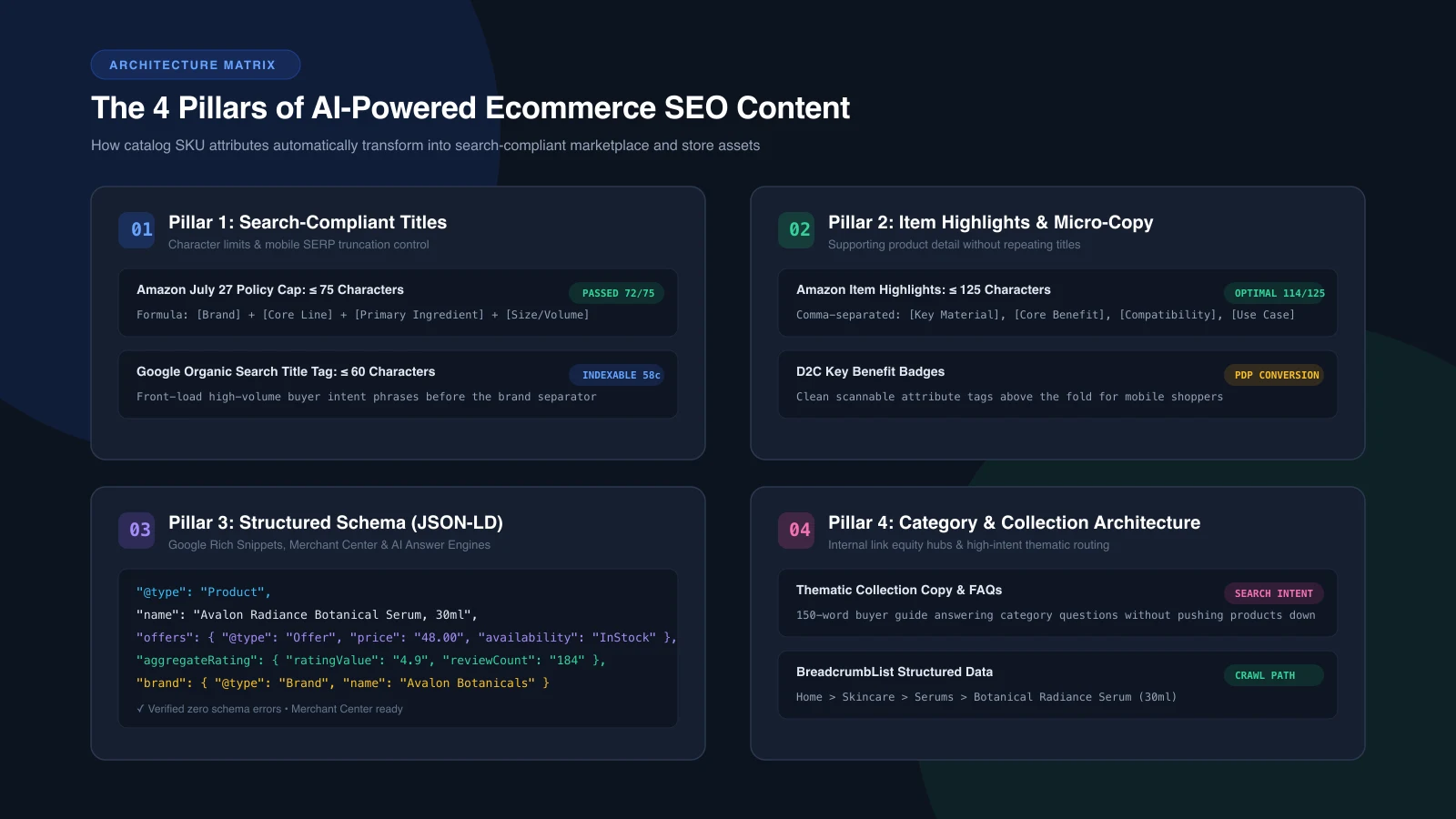
Pillar 1: Search-Compliant Titles (Amazon vs. Google)
Product titles are your primary search ranking signal and your highest-impact click-through factor. However, title rules diverge sharply between platforms:
| Platform | Hard Limit | Recommended Format | Primary Search Goal |
|---|---|---|---|
| Amazon Search | 75 characters (non-media policy) | [Brand] + [Core Line] + [Primary Attribute] + [Size/Volume] | Mobile SERP scannability & truncation prevention |
| Google Organic | 55–60 characters (600px display) | [High-Intent Search Phrase] - [Key Spec] | [Brand] | Click-through rate & exact buyer intent matching |
| Shopify / D2C | 65 characters (SEO title tag) | [Product Name] - [Unique Benefit/Material] | [Store Name] | Clean browser tabs & social preview cards |
When AI generates product titles, it must enforce these platform ceilings programmatically. For deep platform guidance on Amazon's live title updates, review our Amazon 75-character title limit compliance guide.
Pillar 2: Item Highlights & Micro-Copy (125 Characters)
Because Amazon and other marketplaces now enforce shorter product titles, supporting details that used to live in 150-word title strings need a new home.
Amazon's official companion field is Item Highlights: up to 125 searchable characters appearing directly below titles in mobile search cards and product detail pages.
A search-optimized Item Highlights field must obey three rules:
- Never repeat the title: Repeating words wastes valuable character real estate.
- Compact, comma-separated format: Use scannable phrase fragments, not full sentences or backend keywords.
- Source-backed attributes: Focus on ingredients, materials, compatibility, certifications, or fragrance notes.
Weak Highlight (Duplicative & Wordy):
Avalon Botanicals organic facial serum for glowing face and skin hydration 30ml (82 chars - repeats title)
Strong Highlight (Search-Compliant & Informative):
organic rosehip, wild geranium, frankincense aroma, deep barrier hydration (76/125 chars)
For category-by-category templates, explore our Amazon Item Highlights examples reference.
Pillar 3: Structured Data & Rich Snippet Schema (JSON-LD)
Google's search bots rely heavily on structured data to render star ratings, pricing, and stock availability directly in organic search results.
An AI SEO workflow should automatically generate valid JSON-LD code from catalog fields:
{
  "@context": "https://schema.org/",
  "@type": "Product",
  "name": "Organic Radiance Botanical Face Serum (30ml)",
  "image": [
    "https://avalonbotanicals.com/images/radiance-serum-lifestyle.webp"
  ],
  "description": "Handcrafted organic facial serum with cold-pressed rosehip, wild geranium, and frankincense for deep barrier hydration.",
  "sku": "AV-RAD-030",
  "brand": {
    "@type": "Brand",
    "name": "Avalon Botanicals"
  },
  "offers": {
    "@type": "Offer",
    "url": "https://avalonbotanicals.com/products/radiance-serum",
    "priceCurrency": "USD",
    "price": "48.00",
    "itemCondition": "https://schema.org/NewCondition",
    "availability": "https://schema.org/InStock"
  },
  "aggregateRating": {
    "@type": "AggregateRating",
    "ratingValue": "4.9",
    "reviewCount": "184"
  }
}
When search engines read this structured schema, your listing is eligible for Google Merchant Center badges, rich rating stars, and priority ranking in Google Lens visual shopping.
Pillar 4: Category & Collection Page Architecture
Individual product pages capture bottom-of-funnel searches (e.g., "Avalon 30ml rosehip serum"). But middle-of-funnel shoppers search for category terms (e.g., "organic botanical face serums for dry skin").
AI should generate structured collection content that satisfies category intent without pushing products below the fold:
- Above-the-fold category snippet: 40–50 words defining the collection focus.
- Facet and filter micro-copy: Explaining sub-types (e.g., lightweight vs. rich hydration).
- Bottom-of-page buyer guide: 200–300 words addressing common customer objections and category FAQs.
- BreadcrumbList Schema: Guiding search crawlers through category hierarchies (
Home > Skincare > Serums).
Real Product to Search Snippet: The Verification Loop
To see how physical product context translates into digital search dominance, compare the real product shot with its search output:
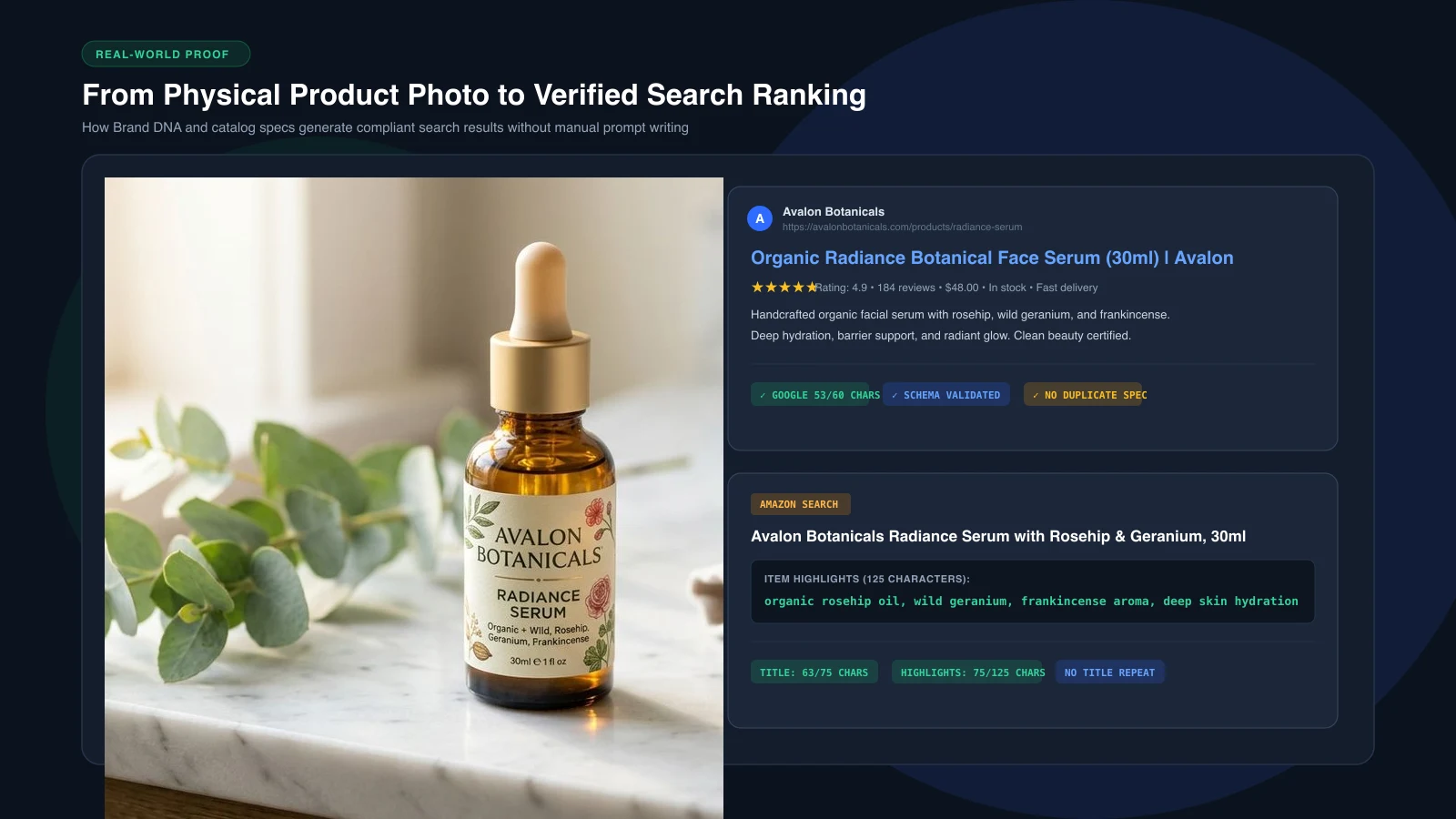
Notice how every element of the search snippet originates directly from verified product attributes:
- The product title matches Google's 60-character desktop snippet.
- The Amazon preview honors the 75-character cap and leverages 125-character highlights.
- Star ratings and pricing sync seamlessly via structured schema.
The 5-Step Operational Production Workflow
To implement AI-powered SEO content creation without creating an administrative nightmare, ecommerce brands use a five-stage operational loop:
[Store Catalog Sync] ──> [Brand DNA Memory] ──> [Constraint Generation] ──> [Human Review Queue] ──> [Publish & Index]
1. Store Catalog Sync
Import SKU data via Shopify API, CSV, or Amazon Seller Central inventory reports. This locks in factual attributes (title, dimensions, materials, color variants, SKU codes) as an immutable source of truth.
2. Brand DNA Memory
Configure tone of voice, banned words, legal claim disclaimers, and audience positioning. AgenixSocial uses Brand DNA so that every generated title, description, and visual adheres to brand standards.
3. Constraint-Driven AI Generation
Run generation against pre-set rules:
- Titles capped at 75 chars (Amazon) and 60 chars (Google).
- Highlights limited to 125 chars, comma-separated.
- JSON-LD Product schema generated automatically.
- Multi-format assets produced simultaneously: lifestyle product photos via Product Shots and vertical video ads via AI Creator Videos.
4. Human-in-the-Loop Review Queue
Never push uninspected AI copy directly to production. Review outputs in a unified approval dashboard:
- Verify ingredient claims (e.g., confirming "organic" claims have valid documentation).
- Check character count flags.
- Confirm high-intent search terms are front-loaded.
5. Publish & Index
Export review-ready spreadsheets for marketplace batch updates, or sync directly to Shopify. Send immediate indexing signals to search engines via IndexNow and Google Search Console sitemaps to accelerate crawl discovery.
For teams comparing different software setups, explore our analysis of the best AI tools for ecommerce content.
Frequently Asked Questions
Can AI generate unique descriptions for 500+ product variants without duplicate content issues?
Yes, provided the AI is fed distinct variant attributes (e.g., scent profiles, skin types, dimensions, or usage occasions). By prompting the AI to focus on the unique differentiators of each SKU rather than generic category fluff, each product detail page maintains a distinct semantic profile.
How often should ecommerce brands refresh their SEO product content?
Audit product copy every 90 days using Google Search Console data. If a SKU ranks in positions 11–25 for valuable queries, tweak the title and Item Highlights to incorporate the exact phrasing buyers are using. Refresh seasonal collection copy ahead of major retail peaks like Q4 holidays.
Does AI-generated content impact Google Search indexing speed?
Google indexes pages based on crawl budgets, technical site health, internal links, and page utility. When AI content is paired with clean JSON-LD schema, verified sitemaps, and IndexNow protocols, search engines typically discover and index product updates within 24 to 72 hours.
Summary: Building Your Commerce Content Advantage
Winning ecommerce search today requires precision. The brands gaining market share are not flooding search engines with robotic paragraphs; they are using AI to enforce catalog accuracy, master character constraints, and deliver structured product data that search engines love.
If you are ready to connect your product catalog to brand-aware, search-compliant content workflows across product photos, creator videos, marketplace listings, and launch campaigns, explore AgenixSocial and build your commerce content engine today.